Showing posts with label humanism. Show all posts

Friday, May 16, 2025

An Atheist's Confession of Faith

Only fools say in their hearts, "There is no God." They are corrupt, and their actions are evil; not one of them does good!  (Psalm 14:1, Psalm 53:1 NLT)

All men live by faith, both the just and unjust. It is impossible for men not to have a belief system. It is by faith that they have eternal life or eternal damnation because their belief system is either true or false.

Atheism and secular humanism are belief systems, just like any other religions. Here is an atheist's confession of faith by Richard Charles Lewontin (1929–2021) quoted from this article "Remembering a Biologist’s Remarkable Confession of Faith | Mind Matters".

QUOTE
In 1997, Lewontin published a review of celebrity science commentator Carl Sagan's book The Demon-Haunted World in which he blurted:

"Our willingness to accept scientific claims that are against common sense is the key to an understanding of the real struggle between science and the supernatural. We take the side of science in spite of the patent absurdity of some of its constructs, in spite of its failure to fulfill many of its extravagant promises of health and life, in spite of the tolerance of the scientific community for unsubstantiated just-so stories, because we have a prior commitment, a commitment to materialism. It is not that the methods and institutions of science somehow compel us to accept a material explanation of the phenomenal world, but, on the contrary, that we are forced by our a priori adherence to material causes to create an apparatus of investigation and a set of concepts that produce material explanations, no matter how counter-intuitive, no matter how mystifying to the uninitiated. Moreover, that materialism is absolute, for we cannot allow a Divine Foot in the door. The eminent Kant scholar Lewis Beck used to say that anyone who could believe in God could believe in anything. To appeal to an omnipotent deity is to allow that at any moment the regularities of nature may be ruptured, that miracles may happen."

Richard Lewontin "Billions and Billions of Demons" at New York Review of Books (January 9, 1997)
UNQUOTE

This is a link to a shorter version of quotation taken from A-Z Quotes | Quotes for All Occasions.

So, any scientific evidence for God would be rejected by atheists because they have "a commitment to materialism ... forced by our a priori adherence to material causes" and the belief that "materialism is absolute, for we cannot allow a Divine Foot in the door ... that anyone who could believe in God could believe in anything".

For what may be known about God is plain to them, because God has made it plain to them. For since the creation of the world God’s invisible qualities, His eternal power and divine nature, have been clearly seen, being understood from His workmanship, so that men are without excuse. For although they knew God, they neither glorified Him as God nor gave thanks to Him, but they became futile in their thinking and darkened in their foolish hearts. (Romans 1:19-21 BSB)

Professing to be wise, they became fools, and they changed the glory of the immortal God into a likeness of an image of mortal man and birds and quadrupeds and creeping things. (Romans 1:22-23 BLB)

Tuesday, October 8, 2024

Gods of the Gaps

Thus shall you say to them: "The gods who did not make the heavens and the earth shall perish from the earth and from under the heavens." (Jeremiah 10:11 ESV)

Secular humanists believed that gods were created to fill our gaps in knowledge. When they did not know how rain was made, they created a rain god. When they could not explain the thunder, they created a thunder god. As our knowledge increase, there will be less and less requirement for divine explanation. Eventually, when we know everything, god or gods will cease to exist.

And this is exactly what the Bible said about the so-called gods who did not make the heavens and earth. They will vanish from the earth and from under the heavens (Jeremiah 10:11). And exactly as the Bible said, there is one God who stubbornly refused to go away. This is the God that created the heavens and the earth. Till today, science could not come up with a satisfactory answer to creation. So, the God that created the heavens and the earth is still keeping His job.

For thus says the LORD, who created the heavens (He is the God who formed the earth and made it, He established it and did not create it a waste place, but formed it to be inhabited), "I am the LORD, and there is none else. (Isaiah 45:18 NASB95)

Saturday, September 2, 2023

Four Civilizations - 2

In the days of those kings, the God of heaven will set up a kingdom that will never be destroyed, nor will it be left to another people. It will shatter all these kingdoms and bring them to an end, but will itself stand forever. (Daniel 2:44 BSB)

According to Arnold Toynbee in "A Study of History", there are 21 civilizations. They are: Egyptian, Andean, Sumerian, Babylonic, Hittite, Minoan, Indic, Hindu, Syriac, Hellenic, Western, Orthodox Christian (having two branches: the main or Byzantine body and the Russian branch), Far Eastern (having two branches: the main or Chinese-Korean body and the Japanese branch), Islamic (having two branches which later merged: Arabic and Iranic), Mayan, Mexican and Yucatec, which can be tabulated as follow:

1st Generation2nd GenerationUniversal Church3rd Generation
MinoanHellenic (Greek and Roman)ChristianWestern; Orthodox-Russian; Orthodox-Byzantine
Syriac Society (Ancient Israel, Phoenicia etc.)IslamIslamic (at early stages divided into Iranian and Arabic, civilizations, which later were unified)
ShangSinic (see also Han Dynasty)Mahayana (Buddhism)Chinese; Japanese-Korean ("Far Eastern")
IndusIndicHinduismHindu
Egyptiac--
SumericHittite; Babylonian--
Andean; Mayan; Yucatec; Mexican--

While I may not totally agree with Arnold Toynbee's classification, I do agree with him that in the end, four civilizations survived, the humanist Chinese, the polytheistic Indians, the two monotheistic civilizations based on Bible and Koran. The three civilizations which are not Bible-based remain at more or less the same level, making not much progress between the second and third generation. Only the Bible-based European civilisation grew to dominate the world with science and technology. The Bible has always insisted on objective verification in key doctrines and objective verification is what science is all about.

There is some parallel between China in the east and Europe in the west. The second generation Han China and Roman empire fell to barbarians and foreign religions (Buddhism and Christianity respectively) roughly at the same time. The Chinese synthesized Confucianism and Buddhism and revived. The Romans died and the European barbarians took over and built a Bible-based civilization on top of the Greek and Roman foundations.

Arnold Toynbee saw the parallel but could not understand why the Chinese civilisation revived but the Roman civilization died and was replaced by the Europeans. He did not know that God wanted to use the foolish European barbarians to conquer the wise of the world. Furthermore, God has to punish the Romans for their crucifixion of Christ, destruction of Israel and persecution of Christians.

Instead, God has chosen what is foolish in the world to shame the wise, and God has chosen what is weak in the world to shame the strong. God has chosen what is insignificant and despised in the world - what is viewed as nothing - to bring to nothing what is viewed as something, so that no one may boast in his presence. (1 Corinthians 1:27-29 CSB)

Tuesday, January 24, 2023

Setting KPI For God

For behold, I am raising up the Chaldeans - that ruthless and impetuous nation which marches through the breadth of the earth to seize dwellings not their own. (Habakkuk 1:6 BSB)

Men love to set KPI. They even set KPI for God on how a perfect God should be like. Did God accept the KPI?

Crime and Punishment
When Israel sinned, God ought to use a more righteous nation to punish Israel or punish Israel Himself. But God raised the cruel Babylonians to punish Israel (Habakkuk 1:6). And then God later punished the Babylonians for punishing Israel (Jeremiah 25:12).

Word Transmission
Until heaven and earth shall pass away, not one jot or one tittle shall pass away from the law (Matthew 5:18) but in the course of transmission of text of the Bible, there are some minor changes in the jot and tittle. It is less than 0.01%, but still, it is one missing jot or one additional tittle. But the KJV-only believers cannot believe that the almighty God could not preserve a perfect original text for us. God would fail our KPI for Him if He cannot do that. In fact, He did more than that. He even divinely inspired the KJV translation. God passed our KPI for Him with flying colours. Did God really care about our KPI for Him?

Word Accuracy
It is appointed for man to die once (Hebrews 9:27) but Lazarus died twice (John 11:43). Did the Bible contradict itself? Is the mustard seed the smallest of all seeds (Matthew 13:32, Mark 4:31)? If Jesus was to be in the grave three days and nights (Matthew 12:40), how do we fit those between Good Friday and Easter Sunday? Did Bible meant it to be 72 hours exactly because God is very precise? Three days and nights must be 72 hours because God is perfect to the jot and tittle. Are we celebrating Good Friday and Easter Sunday wrongly? Or are we interpreting the Bible more strictly than God Himself?

Christian Witness
The Bible recorded that God use holy men like the apostles to spread the gospel. But in our days, God chose to use the colonialist, the slave traders and drug traffickers to spread the gospel. Africans were enslaved, taken from their home and sold to Christian lands to be given the opportunity to hear the gospel. Opium traders humiliate China to bring the gospel to their land. Shouldn't a perfect and holy God do better than that? Maybe He should roll out the red carpet to welcome the Africans and Chinese into the Kingdom of God and today, there will be no Black Life Matter movement and there will be no Chinese Communist party harping on the century of humiliation by Western imperial powers. Looks like we have better ideas than God.

World Creation
Then the ultimate KPI, the favourite of unbelievers and atheists, why can't the perfectly good, almighty and all-knowing God create a world without sin? Then Jesus would not need to come to the world to die for sin. Atheists use God's failure in this KPI to prove His non-existence. If God exists, why are there evil and sufferings in the world? Why can't the One who knows the end from the beginning think ahead?

What are you going to do with a God that fail your KPI?

From that time on many of His disciples turned back and no longer walked with Him. (John 6:66 BSB)

So Jesus asked the Twelve, "Do you want to leave too?" Simon Peter replied, "Lord, to whom would we go? You have the words of eternal life. We believe and know that You are the Holy One of God." (John 6:67-69 BSB)

Saturday, November 5, 2022

End Of Secularism

"Therefore say to the house of Israel, Thus says the Lord God: It is not for your sake, O house of Israel, that I am about to act, but for the sake of my holy name, which you have profaned among the nations to which you came. And I will vindicate the holiness of my great name, which has been profaned among the nations, and which you have profaned among them. And the nations will know that I am the Lord, declares the Lord God, when through you I vindicate my holiness before their eyes. I will take you from the nations and gather you from all the countries and bring you into your own land. (Ezekiel 36:22-24 ESV)

God restored Israel to vindicate the holiness of His great name in the eyes of the nations. But the nations still refused to recognise the God of Israel. So there will be the Gog and Magog war where God will defeat Gog miraculously. And that will end secularism.

So I will show my greatness and my holiness and make myself known in the eyes of many nations. Then they will know that I am the LORD. (Ezekiel 38:23 ESV)

So I will make my holy name known among my people Israel and will no longer allow it to be profaned. Then the nations will know that I am the LORD, the Holy One in Israel. (Ezekiel 39:7 CSB)

Thursday, November 3, 2022

Israel-Palestinian Problem - A Secular Solution

But I have chosen Jerusalem, that my name might be there; and have chosen David to be over my people Israel. (2 Chronicles 6:6 KJV)

Moreover, the word of the LORD came to Jeremiah: "Have you not noticed what these people are saying: 'The LORD has rejected the two families He had chosen'? So they despise My people and no longer regard them as a nation. This is what the LORD says: If I have not established My covenant with the day and the night and the fixed order of heaven and earth, then I would also reject the descendants of Jacob and of My servant David, so as not to take from his descendants rulers over the descendants of Abraham, Isaac, and Jacob. For I will restore them from captivity and will have compassion on them." (Jeremiah 33:23-26 BSB)

This interesting video "Who Controlled Jerusalem the Longest? - YouTube" gave us a rational basis for a secular solution to the Israel-Palestinian problem. It concluded at the end of the video that since the Muslims controlled Jerusalem for 1283 years and the Jews for 1197 years, then it ought to be a two-state solution. I think for all those people who do not believe in the Bible, he has a very good case.

But both the Jews and the Muslims will not accept the solution. Neither will the Bible believing Christians. Above all, the God who created the heavens and the earth will bring to pass all that He had purposed. God is the factor overlooked in secular solution.

On that day, when all the nations of the earth gather against her, I will make Jerusalem a heavy stone for all the peoples; all who would heave it away will be severely injured. (Zechariah 12:3 BSB)

The LORD of Hosts has sworn: As I have purposed, so it will be; as I have planned it, so it will happen. (Isaiah 14:24 CSB)

I declare the end from the beginning, and from long ago what is not yet done, saying: my plan will take place, and I will do all my will. (Isaiah 46:10 CSB)

Saturday, October 22, 2022

Where Did the First Atom Came From?

In the beginning, God created the heavens and the earth. The earth was without form and void, and darkness was over the face of the deep. And the Spirit of God was hovering over the face of the waters. And God said, "Let there be light," and there was light. And God saw that the light was good. And God separated the light from the darkness. God called the light Day, and the darkness he called Night. And there was evening and there was morning, the first day. (Genesis 1:1-5 ESV)

In this YouTube video "How Did the First Atom Form? Where did it come from? | Big Bang Nucleosynthesis - YouTube", Arvin Ash tried to explain how the universe came about via a big bang. But the big bang needs way too many Goldilocks moments (not too hot, not too cold, just right) to make things happen.

The Bible tells us that God created the heavens and the earth in six days. It is not a big bang. Molecule to man evolution is just not true. Uncaused existence is just not possible.

Friday, October 21, 2022

Secular Humanist Artificial Intelligence Myth

We're headed toward a situation where AI is vastly smarter than humans and I think that time frame is less than five years from now. But that doesn't mean that everything goes to hell in five years. It just means that things get unstable or weird.
Elon Musk: The Maureen Dowd Interview - The New York Times 2020-07-25

Secular humanists think that religions are myths. But secular humanists also create their own myths.

Secular humanists believe in nature and the material world. God or gods are invoked to fill in the blanks in our knowledge. For example, when we do not know how rain and thunder works, we created rain god and thunder god. As our knowledge increase, there will be less and less requirement for divine explanation. Eventually, when we know everything, god or gods will cease to exist.

Why do secular humanists think like this?

It is because they have a superior view of man and an inferior view of God and God's creation, also known as nature. They believe that in due time, man will understand everything. Because they have a superior view of man, they also believe that man's creation, also known as artificial intelligence, can take over the world.

Monday, October 11, 2021

Universally Acceptable Behaviours

You are to undergo circumcision, and it will be the sign of the covenant between me and you. For the generations to come every male among you who is eight days old must be circumcised, including those born in your household or bought with money from a foreigner - those who are not your offspring. (Genesis 17:11-12 NIV)

On the eighth day the boy is to be circumcised. (Leviticus 12:3 NIV)

Imagine there is a country where it is legally mandatory to blind every citizen in the right eye so that they can only have a left eyed view. If anyone have two eyes in this country, it would be considered as illegal and injustice to the rest of the citizens. All citizens are taught this from young and accept this a true and right. But to the rest of the world, this country has a cruel practice.

The Jews circumcised their baby boys on the eighth day. The boys are not given an option to reject and every Jew is taught that this is true and right. This article "Can the religious beliefs of parents justify the nonconsensual cutting of their child's genitals? | Practical Ethics" believed that circumcision of male babies is not right. Is this a cruel practice?

So who decides what is a cruel practice? Where is the line drawn? Who decides what is universally accepted? Only the creator and owner of the world has the right to decide. Thus, if you think you have the right, please prove that you have created the world and owned it.

Then there are others who think that "man is the measure of all things (Protagoras)" and there may be no God. So they think it can be decided by reason, science, consensus and democracy. Unfortunately, truth cannot be decide by democracy and even if 100% of the world voted that 1+1=3, it will still not be true. So finally it will be decided by the size of the military and political influence.

In those days Israel had no king; everyone did as they saw fit. (Judges 21:23 NIV)

For although they knew God, they neither glorified him as God nor gave thanks to him, but their thinking became futile and their foolish hearts were darkened. Although they claimed to be wise, they became fools and exchanged the glory of the immortal God for images made to look like a mortal human being and birds and animals and reptiles. (Romans 1:21-23 NIV)

Thursday, July 15, 2021

The Great Awokening

The following quote is taken from Wikipedia:

QUOTE
Woke (/ˈwoʊk/ WOHK) is a term, originating in the United States, that originally referred to awareness about racial prejudice and discrimination. It subsequently came to encompass an awareness of other issues of social inequality, for instance regarding gender and sexual orientation. Since the late 2010s, it has also been used as a general term for left-wing political movements and perspectives which emphasise the identity politics of people of color, LGBT people, and women.
UNQUOTE

There is one more perspective of woke - it is anti-White and anti-Bible.

Saturday, July 6, 2019

Primordial Soup

Quote taken from this BBC website, "BBC - Earth - The secret of how life on Earth began":
"Every single person who died before Darwin published Origin of Species in 1859 was ignorant of humanity's origins, because they knew nothing of evolution."

Thank God for those who were born before 1859! At least some of them knew this, which is far better:
So God created man in his own image, in the image of God created he him; male and female created he them. (Genesis 1:27 KJV)

The following was also quoted from the same article:
QUOTE
Darwin knew that it was a profound question, but - perhaps wary of starting yet another fight with the Church - he only seems to have discussed the issue in a letter written in 1871. His excitable language reveals that he knew the deep significance of the question:
"But if (& oh what a big if) we could conceive in some warm little pond with all sorts of ammonia & phosphoric salts, - light, heat, electricity &c present, that a protein compound was chemically formed, ready to undergo still more complex changes..."
In other words, what if there was once a small body of water, filled with simple organic compounds and bathed in sunlight. Some of those compounds might combine to form a life-like substance such as a protein, which could then start evolving and becoming more complex.
It was a sketchy idea. But it would become the basis of the first hypothesis for how life began.
This idea emerged from an unexpected place. You might think that this daring piece of free thinking would have been developed in a democratic country with a tradition of free speech: perhaps the United States. But in fact the first hypothesis for the origin of life was invented in a savagely totalitarian country, where free thinking was stamped out: the USSR.
In Stalin's Russia, everything was under the control of the state. That included people's ideas, even on subjects - like biology - that seem unrelated to Communist politics.
Most famously, Stalin effectively banned scientists from studying conventional genetics. Instead he imposed the ideas of a farm worker named Trofim Lysenko, which he thought were more in line with Communist ideology. Scientists working on genetics were forced to publicly support Lysenko's ideas, or risk ending up in a labour camp.
It was in this repressive environment that Alexander Oparin carried out his research into biochemistry. He was able to keep working because he was a loyal Communist: he supported Lysenko's ideas and even received the Order of Lenin, the highest decoration that could be bestowed on someone living in the USSR.
In 1924, Oparin published his book The Origin of Life. In it he set out a vision for the birth of life that was startlingly similar to Darwin's warm little pond.
Oparin imagined what Earth was like when it was newly formed. The surface was searingly hot, as rocks from space plunged down onto it and impacted. It was a mess of semi-molten rocks, containing a huge range of chemicals – including many based on carbon.
Eventually the Earth cooled enough for water vapour to condense into liquid water, and the first rain fell. Before long Earth had oceans, which were hot and rich in carbon-based chemicals. Now two things could happen.
First, the various chemicals could react with each other to form lots of new compounds, some of which would be more complex. Oparin supposed that the molecules central to life, like sugars and amino acids, could all have formed in Earth's waters.
Second, some of the chemicals began to form microscopic structures. Many organic chemicals do not dissolve in water: for example, oil forms a layer on top of water. But when some of these chemicals contact water they form spherical globules called "coacervates", which can be up to 0.01cm (0.004 inches) across.
If you watch coacervates under a microscope, they behave unnervingly like living cells. They grow and change shape, and sometimes divide into two. They can also take in chemicals from the surrounding water, so life-like chemicals can become concentrated inside them. Oparin proposed that coacervates were the ancestors of modern cells.
Five years later in 1929, the English biologist J. B. S. Haldane independently proposed some very similar ideas in a short article published in the Rationalist Annual.
Haldane had already made enormous contributions to evolutionary theory, helping to integrate Darwin's ideas with the emerging science of genetics.
He was also a larger-than-life character. On one occasion, he suffered a perforated eardrum thanks to some experiments with decompression chambers, but later wrote that: "the drum generally heals up; and if a hole remains in it, although one is somewhat deaf, one can blow tobacco smoke out of the ear in question, which is a social accomplishment."
Just like Oparin, Haldane outlined how organic chemicals could build up in water, "[until] the primitive oceans reached the consistency of hot dilute soup". This set the stage for "the first living or half-living things" to form, and for each one to become enclosed in "an oily film".
It is telling that of all the biologists in the world, it was Oparin and Haldane who proposed this. The idea that living organisms formed by purely chemical means, without a god or even a "life force", was radical. Like Darwin's theory of evolution before it, it flew in the face of Christianity.
That suited the USSR just fine. The Soviet regime was officially atheist, and its leaders were eager to support materialistic explanations for profound phenomena like life. Haldane was also an atheist, and a devoted communist to boot.
"At that time, to accept or not accept this idea depended essentially on personalities: whether they were religious or whether they supported left or communist ideas," says origin-of-life expert Armen Mulkidjanian of the University of Osnabrück in Germany. "In the Soviet Union they were accepted happily because they didn't need God. In the western world, if you look for people who were thinking in this direction, they all were lefties, communists and so on."
The idea that life formed in a primordial soup of organic chemicals became known as the Oparin-Haldane hypothesis. It was neat and compelling, but there was one problem. There was no experimental evidence to back it up. This would not arrive for almost a quarter of a century.
UNQUOTE

Evolution is faith, not science.
And evolution thrives in ignorance.

Tuesday, July 2, 2019

Secular Version Of Origin Of Israel And Bible

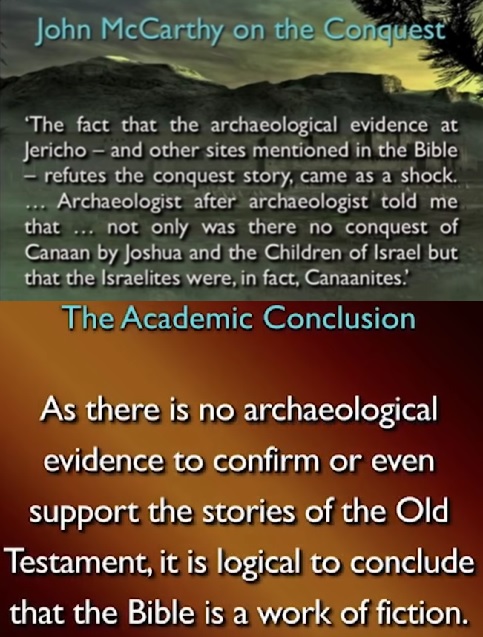
Unbelief. People just don't want to believe that the Bible is true. This YouTube video, "Jewish History - Evidence Of Ancient Israel - Full Documentary" declared that archaeology showed that Israelites are really native Canaanites.

Towards the end of the video, it stated the exile caused to Israelites to reinvent God as the creator God of the universe:
"Something major happened which is very hard to trace. But that was the searing experience, the time of exile. Through the experience of the exile and writing the Bible the concept of God as it is known today is born. In a way, it recreated something which was much greater because it was greater than any individual, land or kingdom, it was a kind of universal religion based on a creator God not just a God of a single nation but the God of the world, the God of the universe."

The god of this age has blinded the minds of unbelievers, so that they cannot see the light of the gospel that displays the glory of Christ, who is the image of God. (2 Corinthians 4:4 NIV)


Another YouTube video "The Biblical Exodus... Fairytale or Historical Fact? (by David Rohl)" interpreting the same archaeological evidence in favour of the Bible.

Sunday, June 2, 2019

Mind And Information

Which come first, mind or information? Based on our observation, mind produce information. But evolution and Buddhism insist that information come first. For evolution, it is the scientific rules. For Buddhism, it is dharma. The Bible agrees with our general observation. The mind comes first. This mind is God.

Monday, May 27, 2019

Christianity And Secular Humanism Compared

Exclusivity
Christians who believe the Bible think that their religion is true and the others are false because only the God of the Bible is true;
Secular Humanists think that their religion is true and the others are false because other religons are just part of the evolutionary process and there is no supernatural forces.

Inclusivity
Christianity is inclusive in that all who believe will be saved but the salvation process and God is exclusive;
Secular Humanism is inclusive because all races, religions, genders, sexual orientations are accepted but the supernatural is excluded.

Human Condition
The Bible tells us that sin is the reason for the sad state of human condition.
Secular Humanism believes that the human condition is the result of evolution.

Salvation
In Christianity, salvation is eternal life through Jesus Christ, who proved that He is the Saviour by His resurrection.
We know that Christ, being raised from the dead, will never die again; death no longer has dominion over him. (Romans 6:9 ESV)
In Secular Humanism, there is no individual salvation. You only live once (YOLO) so make the world better by contributing your life toward the goal.

Be careful that no one takes you captive through philosophy and empty deceit based on human tradition, based on the elements of the world, rather than Christ. (Colossians 2:8 CSB)

Saturday, May 25, 2019

Secular Humanists Thinks All Religion Are The Same

Secular humanist thinks all religions are the same. Here is a quote taken from "Humanism's faith in reason represents our best hope" by AC Grayling published on Sunday 3 March 2013.

QUOTE
Religions, despite what people think of as their personal consolations, have not served the world well. They create division and conflict, they impose unlivable moralities of denial and limitation, and they demand that we think of the world as our remotest ancestors did, thousands of years ago. The cry raised by defenders of religion is: but what would you put in its place as a view of the world by which we can live? The answer is: something far better, deeper, kinder and warmer - and far more rational - namely: humanism.
UNQUOTE

Secular humanists think religions exist for personal consolations. Actually I am not a Christian for personal consolations. I am a Christian because I think the Bible is true. If you can prove to me that the Bible is not true, I am happy to become a secular humanist.

Secular humanism is really just another religion that add to the many conflicting religions. They create new conflicts by adding their morality to the existing confusion. They imposed one-size-fits-all Western European based morality on all societies, thinking that whatever is good for Western Europe is good for the world. They insist on democracy and human rights on all societies, regardless of their religious and cultural background.

They refuse to see the fact that the Bible is different from the other religions and refuse to accept the proofs provided by the Bible.

The Bible does not impose unlivable moralities of denial and limitation.
But the fruit of the Spirit is love, joy, peace, patience, kindness, goodness, faithfulness, gentleness, self-control; against such things there is no law. (Galatians 5:22-23 ESV)

Secular humanists refused to see that they doing the things that other religions do - adding to the existing conflict and confusion without authority and authentication, and thinking that they are the best hope. Don't all religions act the same?

Friday, May 24, 2019

The Problem With Secular Humanism

Problem 1 - God
Secular Humanism assumes that God does not exist. The Bible assumes that God exists. This is a problem for both. The existence or non-existence of God cannot be proven. We are too small and too brief for that.

Bible's solution
The Bible never attempt to prove the existence of God. But the Bible make strenuous effort to prove the authenticity and veracity of the Word of God. In fact, this is the area where Christianity really shines. Christianity is an auditable religion! Other religions were started by one founder who had an idea or a vision (unprovable) or visited by an unseen angel (unseen, therefore nobody know). Buddha, like the secular humanist, offer a solution that does not need God and we have no proof if nirvana is really a solution because nobody ever come back after death to say that nirvana is real. Islam claim that the Koran is the word of God but offer meaningless proofs.

Secular Humanism non-solution
Secular humanism assumes that God does not exist and then proceed to use that as a basis for all their beliefs.

Problem 2 - Reason for Being
Why are we here? If there is no life after death, why should I do good? Why can't I be a Hedonist? Let us face this - if God does not exist and our existence is only temporal, then we all can do evil. This is reasonable and logical. In the first place, why is there good and evil? Evolution is about survival of the fittest, not the noblest. Why should I accept the humanist definition of "goodness"? Why can't I create my own standard and call evil good and good evil? Why must I accept some moral authority which have no basis other than being from another human or from some Western European culture?

Thursday, May 23, 2019

How Religions Got Started - The Secular Humanist Viewpoint

Secular humanist believed that religion got invented because men appeared to be evolutionarily predisposed to religion or religious like behaviour. Below are quotes from this article, "The Human Brain Evolved to Believe in Gods - The Crux":

QUOTE
Leading scholars propose a two-phase hypothesis (here, here): First, our ancestors evolved certain mental abilities, useful for survival and reproduction, which predisposed them to religious beliefs. Then, from the multitude of beliefs that emerged, particular religions spread and persisted because their deities and rituals promoted cooperation among practitioners.
...
Evolved features of our brains, such as Theory of Mind and over-imitation, likely caused the emergence of religions in human societies. It doesn’t take supernatural beings to explain why so many people believe in them - just natural evolutionary processes.
UNQUOTE

As such, to secular humanists, all religions are equal. There is no special revelation in any of them. And science has been able to prove that many of the religious practices are mere superstitions. Because of this, secular humanists refused to give Christianity as special preference. They said if we were to look at the 6 days creation seriously, then we also have to look at the Hindu view that the world is supported by four elephants on a big turtle seriously.

Tuesday, May 21, 2019

Humanism's Faith in Reason represents Our Best Hope

Below is taken from the guardian article, "Humanism's faith in reason represents our best hope" by AC Grayling published on Sunday 3 March 2013.

QUOTE
Religions, despite what people think of as their personal consolations, have not served the world well. They create division and conflict, they impose unlivable moralities of denial and limitation, and they demand that we think of the world as our remotest ancestors did, thousands of years ago. The cry raised by defenders of religion is: but what would you put in its place as a view of the world by which we can live? The answer is: something far better, deeper, kinder and warmer - and far more rational - namely: humanism.

Humanism is a non-religious ethical outlook based on an interest in human affairs at the human scale. It is not a doctrine or a set of rules; it is a starting point, its founding idea being that ethics must be based on the facts of human experience. For some, the result of thinking for themselves about ethics might be close to a conventional moral outlook; for others, the result might be less conventional. Either way, there are just two constraints: that one's choices must not be aimed at harming others, and that one must be able to make a solid case for one's outlook if challenged by others.

One great flaw in religion-based moralities is that they are not thought through and chosen on the basis of individual responsibility, but are imposed from outside in a one-size-fits-all way. As a result, religious morality too often cuts across the grain of human nature, distorting it and crushing its natural impulses, not least as regards sex - always an inflated subject of interest for religious moralists, who throughout history have been frightened of it and bent on limiting it as strictly as possible.

As this shows, humanism is a response to Socrates's invitation to live the chosen life, rather than a life prescribed by doctrines inherited from the traditions, especially the religious traditions, of whatever community one happens to be born into. Religious moralities assume that there is one great truth and one right way to live for everyone. Another great flaw with religious morality is that it says if you do not obey, you will be punished. The threat of punishment is not a logically adequate ground for moral behaviour, even if it is prudent to avoid punishment by behaving as ordered. Unless one's moral outlook comes from being thought-out and chosen for oneself, it is at best an imitation of morality, at worst a subversion of it.

The foundation of a humanist ethic is that it has to start from our best understanding of human nature and the human condition. The "human condition" is somewhat easier to describe than "human nature", that complex thing which literature, psychology, philosophy and individual experience all struggle to understand. Whereas a study of history and a thoughtful reading of literature together offer abundant insights into the human condition, the sheer diversity in human nature makes the task of understanding it a work that could demand whole lifetimes as we seek to make sense of ourselves and others, especially the others we care about.

But the effort to understand human nature is itself constitutive of what makes a good and worthwhile life. It is easy to prove this: consider the opposite, namely, a life lived in carelessness and indifference towards the question of who we are and how we can best relate to others. What a waste that would be. In attempting to understand humanity we can expect to find that what motivates people is, too often, not very admirable and sometimes downright appalling. But this is not the majority story. In every village, town and city in the world, every minute of each day, there are millions of acts of ordinary co-operation, courtesy and kindness, and they constitute the majority of human interactions.

An important assumption that humanism makes is that people are, or at least can be, self-creating and self-determining. But, in many cases, the burden of history and society makes self-creation impossible. This certainly happens when people are trapped in a religious tradition which tells them what to think and how to behave, and refuses to allow them freedom.

But the effort to be a free-minded individual in pursuit of worthwhile goals suited to one's individuality is surely central to the very idea of the good: it is what gives us our best chance to be fully human, and at the same time – in the spirit of shared humanity – to develop our affections in our communities, to promote the values of kindness and tolerance, and to celebrate the enjoyment of all the things that make life beautiful and satisfying.

Because humanism draws on 2,500 years of non-religious ethical thinking since Socrates, it is a deep, rich tradition of insight, wisdom and inspiration, and it is this without any supernaturalistic beliefs involved. That means that it offers the possibility of truly global ethics that everyone could live by. Consider a utopia in which people, having been liberated from religion at last, can agree to base their ethics on a generous view of human nature and needs.
UNQUOTE

Monday, May 20, 2019

Secular Humanism

The following were taken from BBC - Religions - Atheism: Humanism:

QUOTE
Humanists believe that human experience and rational thinking provide the only source of both knowledge and a moral code to live by.
They reject the idea of knowledge 'revealed' to human beings by gods, or in special books.
…
Humanist ideas
Most humanists would agree with the ideas below:
  1. There are no supernatural beings.
  2. The material universe is the only thing that exists.
  3. Science provides the only reliable source of knowledge about this universe.
  4. We only live this life - there is no after-life, and no such thing as reincarnation.
  5. Human beings can live ethical and fulfilling lives without religious beliefs.
  6. Human beings derive their moral code from the lessons of history, personal experience, and thought.
UNQUOTE

Secular humanism views man is the measure of all things (Protagoras). It sees moral values as relative, varying from person to person. It rejects absolutes. It is inclusive. It rejects exclusivity.

"Absolute truth belongs only to one class of humans - the class of absolute fools." Ashley Montagu  (1905 – 1999)

The fool says in his heart, "There is no God." They are corrupt, their deeds are vile; there is no one who does good. (Psalm 14:1 NIV)
The fool says in his heart, "There is no God." They are corrupt, and their ways are vile; there is no one who does good. (Psalm 53:1 NIV)
In those days there was no king in Israel. Everyone did what was right in his own eyes. (Judges 21:25 ESV)

Wednesday, November 28, 2018

Creation Myths

Secular humanist believed that the Bible's account of creation in Genesis is the same as other creation myths. This article "The Top 10 Intelligent Designs (or Creation Myths)" is an example of such belief. They asked this question, "If they allow one belief system to be taught, surely they must also teach others?" Below is the full context of the quote:

QUOTE
Several parents won a lawsuit against a Pennsylvania school district in 2005 that had added the controversial theory of "intelligent design" to its curriculum. Unlike the theory of evolution which is taught at most schools as a fact-based science, "intelligent design" -- as argued by the plaintiffs -- was nothing more than a philosophy predicated on the Judeo-Christian belief that the logical sequences found in nature are not random happenings or surprising mutations, but deftly managed events created by a greater omniscient and omnipresent intelligence with a specific plan. In short, the work of God. A federal judge thought otherwise. But therein lies the rub: Which god? When the founding fathers established the Constitution of the United States, they chose to include the separation of church and state. This was to ensure that the state-sanctioned religious persecutions that plagued much of Europe during the 16th century would not despoil the young, yet grand experiment in democracy that was to become this Republic. Scientific research has come a long way since Charles Darwin first posited the concept of "natural selection." In the intervening years, humanity has learned much about how we became the dominant species on the planet, how the Earth and the solar system were formed and the ever-changing development of the Universe. Over that time, how we understand the theory of evolution has also changed. Scientists now think that there is an intrinsic logic to our reality, that there are absolutes, laws of nature. Much remains a mystery, and as one question is answered, many others arise. The question that faced Pennsylvania's Dover School District was whether or not the imposition of one creation belief on a multi-ethnic, secular student body is in keeping with the law that prohibits the creation of a state religion. If they allow one belief system to be taught, surely they must also teach others? To help out with this dilemma, LiveScience presents a list of those Creation Myths that helped define civilizations both past and present...
UNQUOTE

The article went on to list the top 10 "Intelligent Designs (or Creation Myths)" to demonstrate the problem if all these "myths" were to be taught.
  1. Genesis of the Judeo-Christian and Islamic Faiths
  2. Greek
  3. Hindu
  4. Japan
  5. China
  6. Aztecs
  7. Ancient Egypt
  8. Babylon
  9. Zoroastrianism of Ancient Persia
  10. Norse